
I Beat the Clock
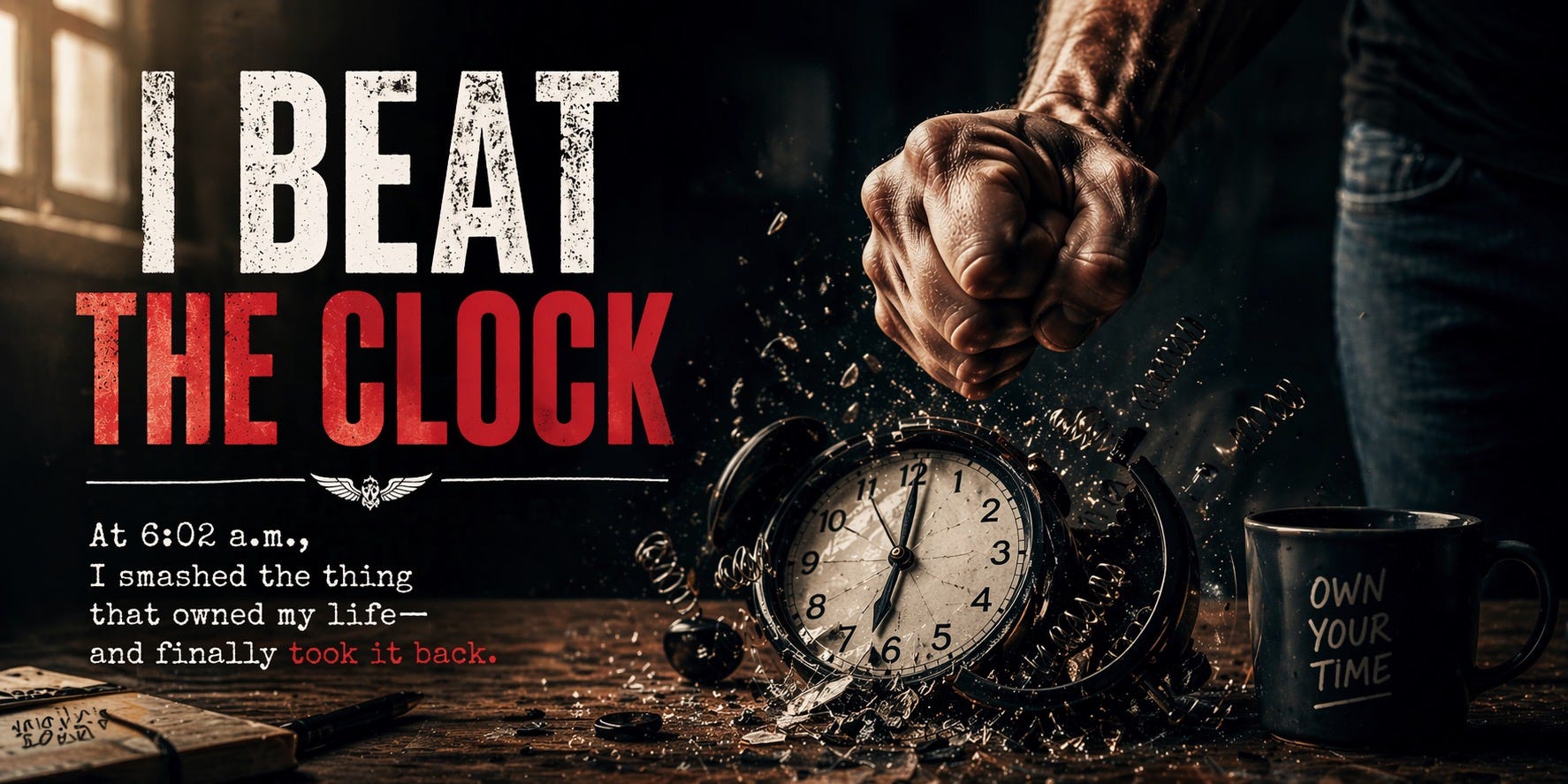
At 6:02 a.m., I smashed the thing that owned my life -- and took it back

People romanticize self-employment. They imagine freedom, sleeping in, waking when the body decides it’s ready, not when some desk jockey in HR dictates. They picture themselves as masters of their destinies, answering to no one.
Here’s the truth no one talks about: When you’re self-employed, you don’t have one boss, you have many. Every client becomes a boss, every project becomes a deadline, and every deadline becomes a clock that owns you.
For years, my life was dictated by ringing phones and Outlook reminders stacked like bricks on a prison wall. People say self-employment gives you flexible hours, but that flexibility only bends one way -- toward your client’s needs. Toward the demands of other people’s emergencies disguised as opportunities.
Early calls, late emails, weekend crises that were never really crises at all -- all of it policed by that little plastic tyrant sitting on my nightstand, monitoring my obedience.
At 6:02 on a Tuesday morning, I snapped.
The alarm screamed beside me, mechanical and smug, dragging me out of whatever dream I had been clinging to. I didn’t think, I didn’t hesitate, I simply lost my mind. Instead of hitting snooze, I drove my fist into it. It kept screaming, so I picked it up, and slammed it on the floor. Plastic burst apart, springs ricocheted across the room, and time itself seemed to die at my feet.
In that moment, I didn’t just break a clock, I murdered obedience.
For decades, the clock told me when to wake, when to grind, and when to send an invoice. It whispered reminders to call people who acted as if the world would stop spinning unless I measured one more parcel, drew one more line, and solved one more problem. But standing over the wreckage, something finally became clear: time is a thief with no remorse. It steals without apology, and it never returns what it took.
We live under a strange religion that worships efficiency. We track our steps, optimize our calendars, and read productivity books like sacred scripture. We build lives that are efficient instead of present, compliant instead of awake, and exhausted instead of alive. No one wants you asking the dangerous questions: What am I racing toward, and why am I obedient to a clock instead of my own life? What if time isn’t something to manage, but something to feel?
I learned this on the road.
Time behaves differently when I travel. In airports, it folds around you like a blanket. On trains, it stretches and thins until moments become hours. In foreign cafés, surrounded by languages you don’t understand, time simply dissolves. You can lose three hours staring out a train window, and feel like you were living well.
Presence slows time. Novelty slows time. Discomfort slows time, but routine kills it.
The clock is the enforcer of routine. Its job isn’t to measure your time, its job is to control it. A clock can tell you you’re late, but it cannot tell you that you’re alive. It can count minutes, but it cannot measure a moment. It can tell you the exact second you woke up, but it can never quantify the sunrise you stood inside, coffee in hand, barefoot on a cold floor. It can track the hours of another pointless meeting, but it cannot track the night you kissed your wife under a streetlamp in Rome, and time stopped breathing altogether.
Smashing that clock didn’t give me more years, but it gave me ownership of the ones I have left. I may not have eternity, but I have agency.
Time is not my master.
I will stretch it, bend it, and spend it on the things that make me feel alive -- travel, writing, and chasing thin places across continents, through sanctuaries, up mountains, and into the eyes of strangers who feel like old friends.
Eventually, reality crept back in. I still have commitments, clients, and responsibilities. I did, in fact, have to buy another clock. Sometimes life demands some structure. Even rebels need an alarm now and then.
But on that morning, when the alarm shattered, and time lay in pieces on the floor, I didn’t answer to a schedule.
For that single, feral moment, I didn’t serve time.
Time served me.
And on that morning, I beat it.
Amen