
Crossing the Gorge
The summer I almost died and became someone new

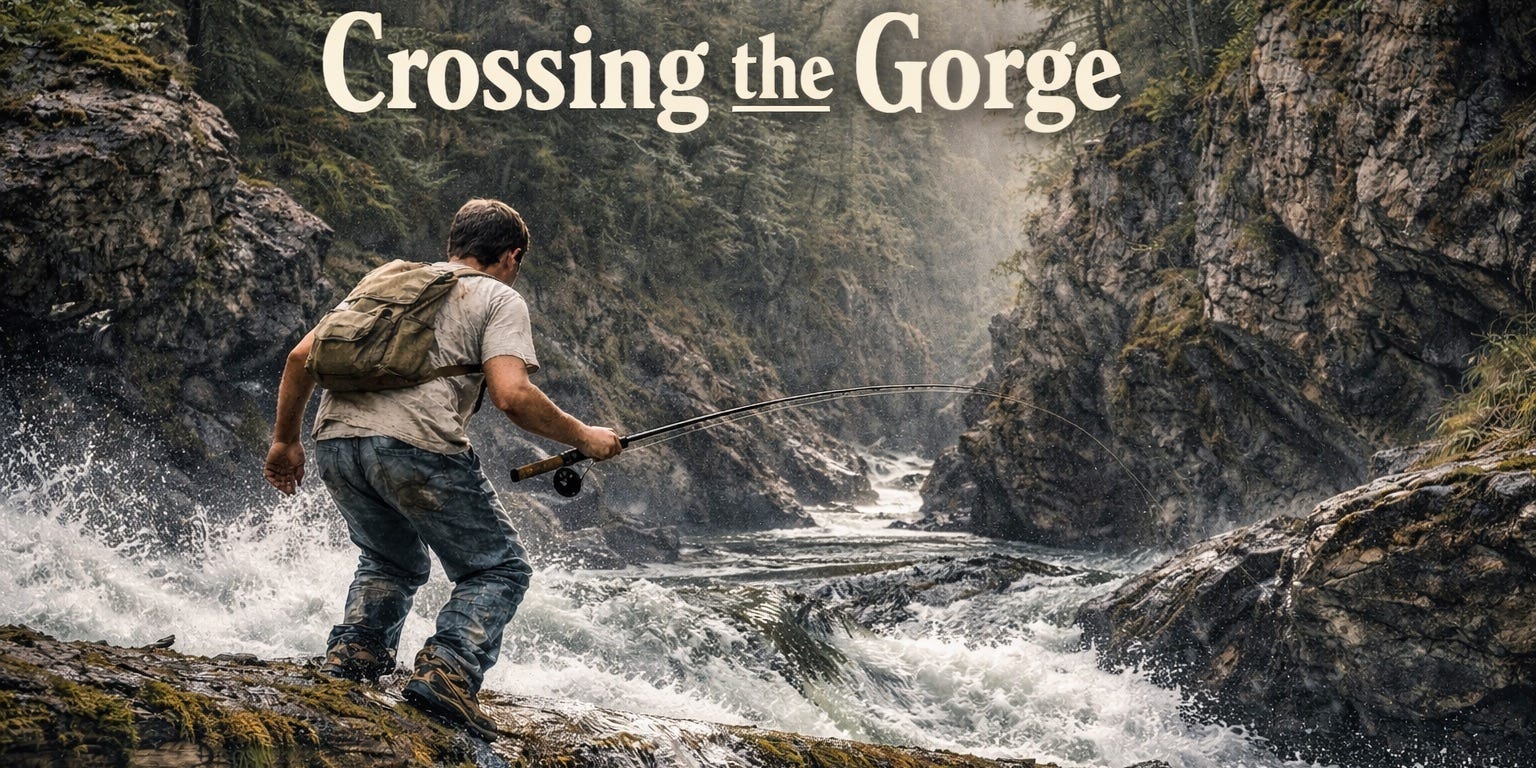
This story originally appeared in the Adelaide Literary Journal in 2017, and was also selected to appear in their best of the year anthology.
I watched my grandpa’s line roll across the water in a smooth arc until his fly landed precisely in a deep pool protected from the current by a large boulder. “That’s where the big ones are,” he shouted at me. His line drifted slowly downstream until it caught the speed of the current. Then he flicked his rod back to the ten-o’clock position, sending the line whizzing back overhead until it became parallel with the earth behind him. He continued the same back-and-forth motion, carving graceful curves through the air, until his fly settled gently back into the pool without a splash.
Watching an expert fly fisherman on the water is akin to watching a ballet dancer. Delicate turns. Precise movements. A performance set to the wind in the trees and the steady babble of the creek. My Grandpa was most certainly an expert. He had been fly fishing since he was a boy, long before it became a sport. He came from a dirt-poor family in eastern Texas where a good day’s fishing could be the difference between a full supper and going hungry.
“Grab the net,” he yelled. His rod bent sideways, forming the shape of the letter U. I scrambled to his position in the creek and waited for him to muscle it in. I watched as he stripped the line through the rod and over his forefinger. The line jerked and shuddered as the fish fought desperately for its life. His left hand slowly pulled in the slack, which floated downstream like a pale ribbon. I often wondered why he didn’t use his reel, but I was afraid to ask.
He fought the monster trout for more than ten minutes. It ran upstream and then downstream. It ducked behind rocks and logs, but my Grandpa shifted his stance, moving his body to flush it out. Finally, he drew the fish close, and I slipped the net beneath it—just in time. As soon as I scooped it up, the fly popped free. “Good job,” my Grandpa said, slapping me on the back.
That’s how I spent the summers of my late adolescence. We were nomads, wandering through Northern California and Oregon in search of fertile rivers. We camped in an old travel trailer pulled by a rusty old International pickup. I often slept outside on the ground, staring up at the stars, or crawled into a pup tent if the weather was bad. Sometimes we found a good spot and stayed for weeks. Other times, we broke camp after a day or two if the fishing wasn’t good.
Each morning, we rose at sunrise. “That was the best time to fish,” my Grandpa told me. We also fished in the late afternoon. “That was the second-best time,” he said. When we weren’t fishing, I did chores around camp or picked wild blackberries for my Grandma to turn into a cobbler. Each night, my Grandpa sat at a small table near the campfire, tying flies in preparation for the next day’s work.
“I’m gonna head upriver and see if I can find another spot,” I told my Grandpa.
“Okay, Drag, just make sure you’re back in time for supper,” he said.
That’s what he called me. He was never happy with the speed I moved, walked, or worked, so he coined the name. Drag was short for drag-ass, and it stuck. That’s what my Grandma and cousins called me until I reached the age of thirteen, when I finally put a stop to it.
In hindsight, I’m not sure my Grandpa ever liked me much. I was a chubby kid from the suburbs with no knowledge of the outdoors. I think he and my Grandma felt it was their responsibility to show me the ways of the country folk—that’s what they called themselves. For three summers, from the age of eleven to thirteen, I spent my breaks learning those ways.
I walked upstream by myself, finally free from the pressure of my Grandpa’s ever-critical eye. Golden shafts of light streamed through the trees, painting the ground in shifting patterns of green and yellow. Mayflies danced in the light before vanishing into shadow. It was a good day to be a boy.
My grandfather taught me the proper way to look at nature. To read the air and the water, to notice what insects were hatching. That was part of the art of fly fishing—to trick the fish into believing your lie. I stopped and pulled a mayfly from my bag and tied it to the end of my leader, cinching it with a knot that resembled a hangman’s noose, just like I’d been taught.
Above my grandfather’s position, the river cut a narrow gorge into solid rock. Straight as an arrow, it flowed without deviation from east to west. The water was swift and violent, churning as it roared through the forest. It certainly wouldn’t be any good for fishing, so I pushed eastward.
I wondered what my friends were doing back home. Probably riding bikes, sleeping late, or playing football in the street. It all felt impossibly far away. But I wasn’t homesick. I was gaining confidence and independence that could never have been found at home. I was becoming a man.
My fishing was improving too. Although I was not yet at my grandfather’s level, I had reached a basic level of competence. My casts were smooth, my arcs long, and I rarely snapped the fly from my leader. My grandfather gave me a limit of two flies per day. Any more than that, and I was forced to fish with salmon eggs on a spinning rod. That was motivation enough. Nobody wanted to be a bait fisherman on the river.\
I tramped along the riverbank, which was thick with wild blackberry bushes and heavy with ripe fruit. I stopped occasionally to grab a handful as I scrambled over rocks and pushed through trees on my way upstream.
After an hour of hiking, I reached the mouth of the channel. The day was late and the shadows were growing long. I wondered if I would make it back to camp before dark. That’s when I spotted a deep pool on the far side of the river, the kind of place that held giant brown or rainbow trout. I studied the water and decided it was too deep and fast to wade across. At its deepest point, it would have reached above my chest. Luckily, I noticed a fallen tree at the mouth of the gorge just wide enough to walk across. The far end was submerged, with water spilling over it. I figured I could walk to that point and jump to the other side.
Carefully, I placed one foot in front of the other as I crossed the narrow log. I held my rod out in front of me for balance like a tightrope walker. When I reached the rushing water, it became obvious the jump was too far, and the log was too narrow to turn around. I had reached an impasse. I watched the water crest over the log and detonate into whitewater below. I figured I could step into the current and launch myself to dry land. Without hesitation, I stepped forward.
Without warning, I was sucked into the river on the upstream side of the log. The instant my foot touched the slick green moss beneath the surface, I was gone. There was no stumble, no loss of balance—it was immediate. I was under the water, my body pinned hard against the log. From the corner of my eye, I saw my rod skip along the rocks at the bottom of the river and disappear into the gorge. I tried to free myself, but the current was relentless. My torso was folded over the log, arms above and legs trailing below.
I didn’t panic. Time seemed to slow and sharpen. The water was clear, and I watched bubbles escape my mouth and drift upward. My stomach burned as a broken branch pierced my skin and tore my shirt. I twisted and fought. Seconds stretched and time became elastic, until the current finally pulled me under and spit me out on the other side of the tree.
When I surfaced, panic arrived all at once. “Help!” I yelled, but there was no one there. My voice echoed through the forest and faded until only the roar of the river remained. I flailed my arms, grasping blindly. I must have looked like an injured bird. Somehow, I caught the tip of a bush hanging over the water. I felt the fibers stretch as the current dragged me under again. Twenty feet away, the water boiled as it entered the gorge. That’s when it occurred to me that I might die. I thought about my Mom and Dad and how devastated they would be. I thought about my Grandpa and how this would only confirm his belief that I didn’t quite measure up. In desperation, I prayed.
Carefully, I reached up with my other hand and grabbed another twig. Inch by inch, I pulled myself closer until my fingers closed around a branch no thicker than my pinky. Finally, I touched dry land. I crawled up the bank and collapsed into a soggy heap.
It was well after dark when I returned to camp. I had to hike upstream another mile to find a safe crossing. Then I got lost in the dark trying to find my way back. Needless to say, my Grandpa was furious.
I didn’t fish again that summer. My Grandpa punished me for being irresponsible and refused to buy me another rod. I spent my final week hiking through the forest or swimming in the river. but, I didn’t care.
After you face death and walk away, everything else feels like a gift.
This inspires me to write a blog about my own travels with Mom and Dad and two sisters when I was a kid. It wasn’t nearly as interesting as this.
This inspires me to write a blog about my own travels with Mom and Dad and two sisters when I was a kid. It wasn’t nearly as interesting as this.